Know the sky. Chase the light.

Will you see the aurora tonight?

Heliocast answers the moment you open it - a plain-language verdict for exactly where you are, built from live NOAA, NASA and ESA space weather. Then it shows you the working: a 3D aurora map, the solar wind, and alerts that only wake you when the sky is actually clear.

Eight live data feeds. Free to use, no account, no ads.

The Heliocast aurora map: a 3D globe showing the live auroral oval over the northern hemisphere, with the day and night terminator

Features

Everything you need to read the night sky

From a one-glance "can I see the northern lights tonight?" verdict to the same solar telemetry professional forecasters watch - without needing a degree to interpret it.

nightlight

Tonight's verdict

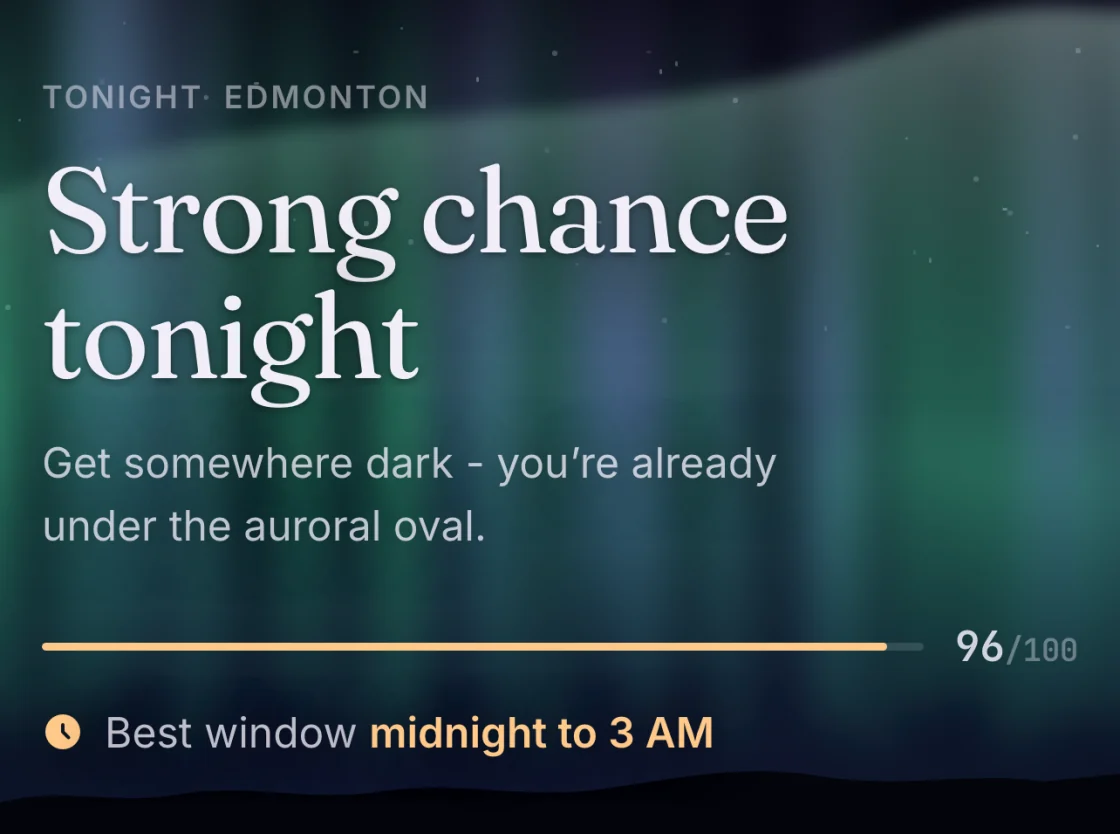
A plain-language answer the moment you open the app, with the reason behind it. A 0-100 visibility score weighs the NOAA aurora forecast against darkness, moon phase and cloud cover for your exact spot - and daylight or overcast can veto it outright.

speed

Live Kp index

The current planetary Kp index straight from NOAA SWPC, backed by the 3-hourly planetary Kp and 1-minute solar-wind telemetry from the L1 point, refreshed continuously.

public

3D aurora map

Spin a real-time globe carrying the OVATION auroral oval and the day/night terminator, so you can see where the aurora is and where it is dark enough to watch it. Six Arctic observatories and all-sky cameras are one tap away.

calendar_month

Which night to go

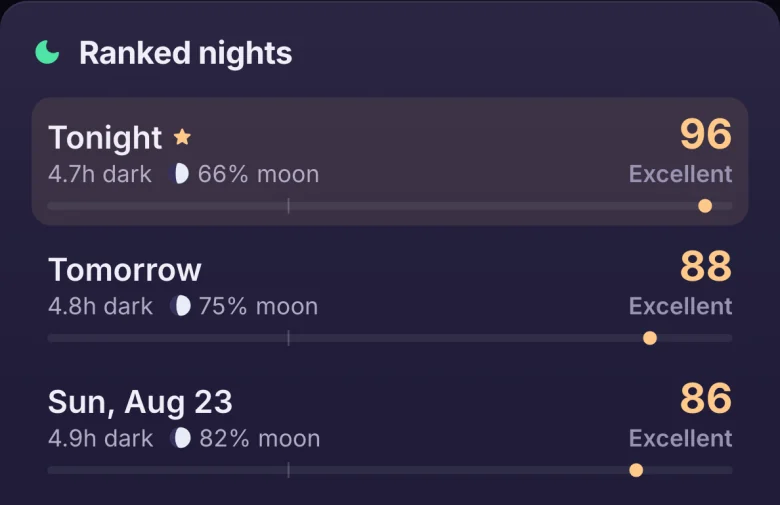
Every night ahead ranked on darkness, moonlight, cloud and the NOAA aurora forecast, plus an hour-by-hour grid for the next three nights. Free ranks tonight and the next two; Pro ranks the full fourteen.

wb_sunny

Sun & solar wind

The SDO solar disk in eight wavelengths plus white-light continuum and magnetogram, SOHO/LASCO coronagraphs, L1 solar wind and the full IMF, GOES X-ray and proton flux, and a CME tracker with arrival times.

notifications_active

Alerts that know your sky

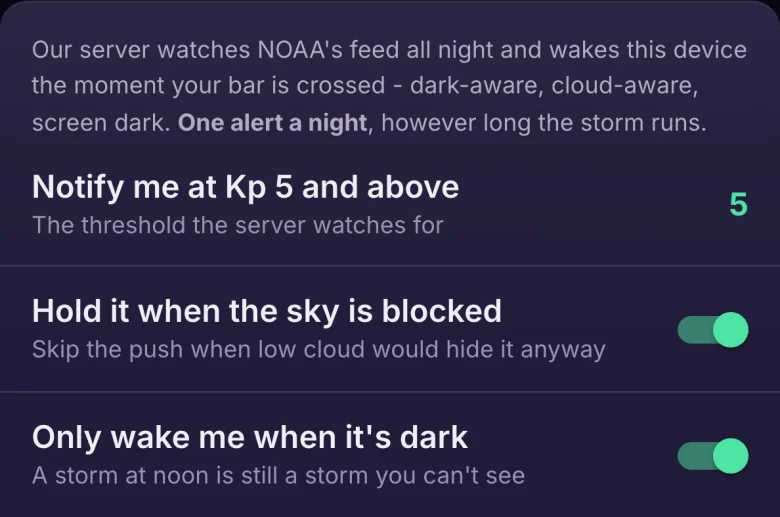
Our server watches NOAA's 1-minute feed all night and wakes your phone the moment your threshold is crossed, with the app closed. Cloud-aware and dark-aware, so a storm you cannot see never rings. One overnight Kp alert is free. Pro adds Bz, wind speed, your own visibility score and quiet hours.

App screens

Complex data, read at a glance

Five tabs, each answering one question. Every screen turns space-weather telemetry into something you can act on in seconds.

Heliocast Tonight screen showing a plain-language aurora verdict, a 0-100 visibility score, and tonight's darkness window, moon phase and cloud cover

Tonight

One clear answer, and why

Open Heliocast and the first thing you get is a human sentence, not a wall of numbers. The score combines the aurora forecast, darkness, the moon and your local cloud - and when the answer is no, it tells you which one of those is the reason.

  • check Plain-language verdict with the limiting factor named
  • check 0-100 visibility score for your coordinates
  • check Tonight's astronomical dark window and its length
  • check Moon phase, cloud cover, live Kp and Bz
  • check Where the auroral oval is sitting right now
Heliocast Nights screen: upcoming nights each scored on darkness, moon and cloud, with an hour-by-hour aurora grid for the next three nights

Nights

Which night should you go?

The question a trip actually turns on. Heliocast ranks the nights ahead for wherever you point it - your location, or the place you are flying to - and breaks the next three into three-hour blocks so you know when to be outside, not just which day.

  • check Every night scored on darkness × moon × cloud × the NOAA forecast
  • check Hour-by-hour grid, 6pm to 6am, for the next three nights
  • check Search and save the place you are travelling to
  • check Tonight plus two nights free; the full 14 with Pro
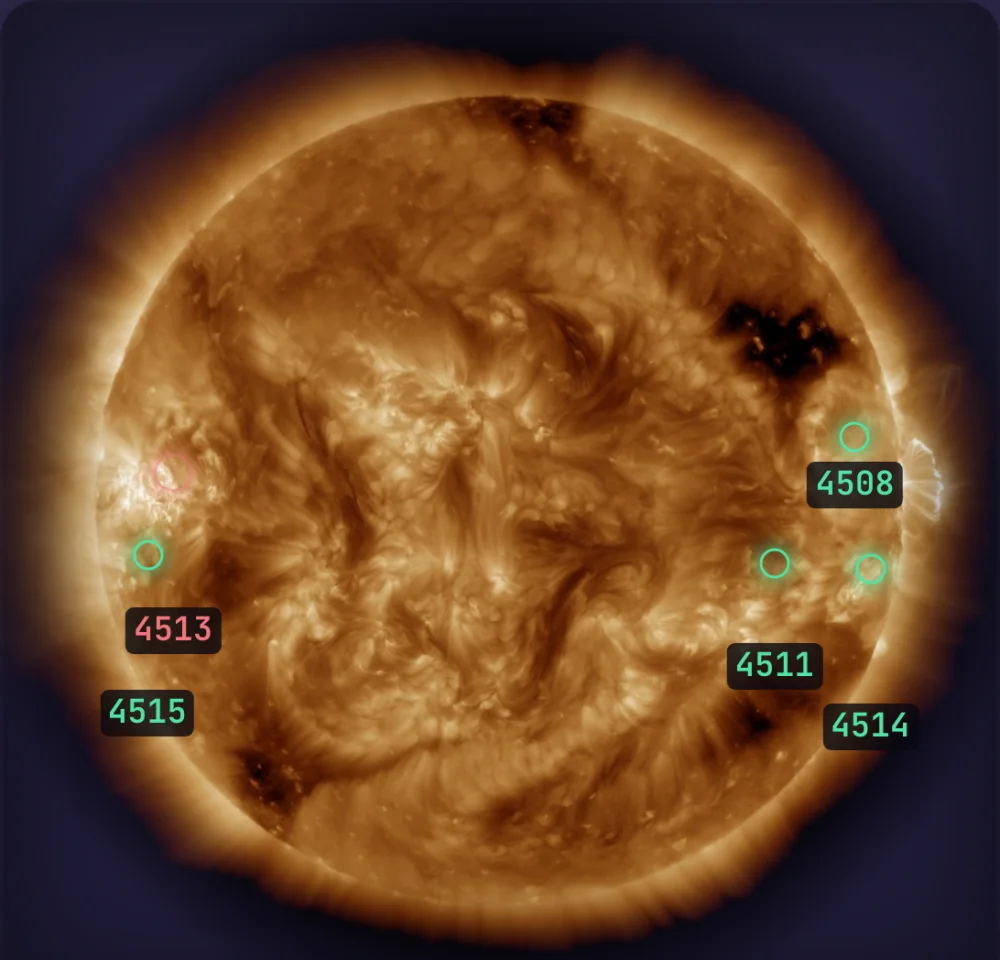
Heliocast solar activity screen showing the NASA SDO/AIA 193 angstrom solar disk with numbered active regions plotted at their heliographic positions

Sun & solar wind

The feeds forecasters actually use

Professional-grade solar imagery and telemetry, presented so it is readable. Watch the active regions that produce flares, the coronagraphs that catch a CME leaving the Sun, and the solar wind arriving at L1 an hour before it reaches us.

  • check NASA SDO disk in eight wavelengths, plus continuum and magnetogram
  • check Active regions plotted at their heliographic positions
  • check SOHO/LASCO C2 and C3 coronagraphs, and GOES CCOR-1
  • check L1 solar wind: speed, density and the full IMF
  • check GOES X-ray and proton flux with flare classes
Heliocast Activity screen listing incoming Earth-directed coronal mass ejections with predicted arrival times and expected Kp

Activity

What is heading this way

Flares, storms and coronal mass ejections, with the part that matters kept in front: when the Earth-directed ones arrive and how big they are expected to be. This is where a good aurora night is visible three days before it happens.

  • check Earth-directed CMEs with predicted arrival and expected Kp
  • check Flare history with classes, and active NOAA alerts
  • check NOAA R, S and G scale status at a glance
  • check Sourced from NASA DONKI and NOAA SWPC
Heliocast alerts screen with a Kp threshold rule, cloud-aware and dark-aware toggles, and overnight push settings

Alerts & journal

Never miss a storm - and never be woken for one you can't see

Set the conditions that matter to you and let Heliocast do the watching. The two toggles that make the difference are on by default: hold the alert when it is cloudy, and hold it when the sun is up. When a display happens, log it - the conditions save themselves, so you learn what works.

  • check Server-side overnight push, with the app closed
  • check Cloud-aware and dark-aware by default
  • check Thresholds on Bz, wind speed and visibility Pro
  • check Quiet hours Pro
  • check Sightings journal with photos, stored on your device
The aurora borealis over a snow-covered northern landscape reflected in still water

Data sources

Eight authoritative feeds, no guesswork

Heliocast aggregates the same public feeds professional space-weather forecasters rely on. Everything is fetched and cached on our server, so the app stays fast and the agencies never see anything about you.

Who it's for

For everyone who watches the sky

photo_camera

Aurora photographers & chasers

Know when and where to set up. Visibility scores, dark-sky windows and alerts that reach you in time to drive out.

cell_tower

Ham radio & HF operators

Track X-ray flux, proton events and the Bz component to anticipate radio blackouts and propagation changes as they unfold.

flight

Travellers & educators

Plan a northern lights trip around the best nights available, and learn the science behind every number in the built-in glossary.

Pricing

Free to use. Pro for the trip.

Heliocast is free forever, with no account and no ads. Pro is a single yearly plan - no monthly tier, no trial countdown, and less than most aurora apps charge for a month. The free tier is the trial.

Free

$0

Forever. No account, no ads


  • check Tonight's verdict and visibility score
  • check Live Kp index and the full 3D aurora map
  • check 3-day forecast and 27-day outlook
  • check Sun, solar wind and radiation telemetry
  • check Arctic observatories and all-sky cameras
  • check Sightings journal, Learn and glossary
  • check Tonight plus 2 ranked nights, 1 saved place
  • check One overnight Kp alert, cloud- and dark-aware
Download free

Heliocast Pro

$4.99

Per year. Auto-renews, cancel anytime

About 42 cents a month.


  • check Everything in Free
  • check The full 14-night ranking, not just three
  • check Up to 10 saved places - home and the trip
  • check Unlimited alerts on Bz, wind speed and visibility
  • check Quiet hours, so it only rings when you'd get up
  • check Weather-radar layer on the globe
  • check Your sightings archive, kept with its conditions
Get Heliocast Pro

Heliocast Pro is a yearly auto-renewing subscription billed through the App Store or Google Play. It renews at the price shown unless cancelled at least 24 hours before the period ends; manage or cancel it any time in your store account settings. Prices are shown in your local currency in the app. Terms of Use · Privacy Policy

Questions

Aurora forecasting, briefly explained

The things people ask before they download an aurora app - and the science behind the numbers Heliocast shows you.

Can I see the northern lights tonight?

That depends on four things at once, which is exactly why Heliocast exists. You need geomagnetic activity strong enough to push the auroral oval over your latitude, a sky dark enough to see it against, a moon that is not washing it out, and no cloud in the way. A high Kp on a cloudy evening in June is worth nothing. Heliocast checks all four for your coordinates and gives you a single answer, plus the reason when the answer is no.
What is the Kp index?

Kp is a 0-9 scale of global geomagnetic disturbance, published by NOAA every three hours. Roughly: the higher the Kp, the further from the poles the aurora is visible. At Kp 0 the auroral oval sits near 66.5° magnetic latitude; by Kp 9 it has pushed down to about 48°. It is the single most quoted aurora number, but on its own it never tells you whether you will see anything, because it says nothing about darkness, the moon or your weather.

What does Bz mean, and why does it matter so much?

Bz is the north-south component of the interplanetary magnetic field carried by the solar wind, measured in nanotesla at the L1 point about a million miles upstream. When Bz turns strongly negative - southward - it links up with Earth's own field and pours energy into the magnetosphere, which is what actually lights the aurora. A sustained negative Bz can produce a better display than a higher Kp with Bz pointing north, and because L1 sits upstream you get roughly 30 to 60 minutes of warning.

Do I need to be in the Arctic?

No. Heliocast works anywhere on Earth, in both hemispheres - the same model handles the aurora australis in Tasmania, New Zealand and southern Chile. During a strong geomagnetic storm the oval reaches well into the mid-latitudes, and the alerts exist precisely so you find out on the nights it does.

Does it work with the app closed?

Yes. Our server watches NOAA's 1-minute feed all night and sends a push the moment your threshold is crossed, whether or not Heliocast is running. One overnight alert is free. It is cloud-aware and dark-aware by default, so it will not wake you for a storm you could not have seen anyway.

When is aurora season?

Anywhere far enough north or south, the limit is darkness rather than the aurora itself. High-latitude summer has no astronomical night at all - the sun never drops the 18° below the horizon that a faint aurora needs - so the practical season runs from roughly late August to mid-April in the north, and the mirror months in the south. Heliocast will tell you plainly when there is simply no night to look at.

What data does Heliocast collect about me?

No account, no ads and no tracking SDKs. Your location is used to compute your forecast and is not sold or shared; the sightings journal, including photos, stays on your device. All the agency feeds are fetched by our server, so NOAA and NASA never see anything about you. The full detail is in the Privacy Policy.

How much does Heliocast Pro cost?

$4.99 per year - one plan, no monthly option and no free trial, because the free tier already is the trial. Pro adds the full 14-night ranking, up to 10 saved places, unlimited precision alerts on Bz, wind speed and your own visibility score, quiet hours, and the weather-radar layer. It renews yearly and you can cancel any time from your App Store or Google Play account.

Is Heliocast on iPhone and Android?

Yes, both - it is a native app on iOS and Android, and the forecast, the 3D map and the alerts are identical on each.

The aurora is out there.

Free to download. No account required.